The conversation around AI is about to shift again. Copilot introduced the idea of AI assistance inside everyday work. The next phase is agentic AI, where software doesn’t just assist people, but also takes action, coordinates tasks and interacts with systems on their behalf.
That’s the context for Agent 365. Microsoft describes it as a single place to observe, govern and secure agents across the organization, with visibility into agents built on Microsoft AI platforms, partner ecosystem agents and agents that an organization registers itself.
Microsoft Agent 365 is a control plane for the agent era
Agent 365 isn’t another interface for interacting with AI. It’s the management layer for a world where organizations may soon have dozens, hundreds or even thousands of agents operating across workflows, data and systems.
Positioned as a control plane within the Microsoft 365 admin center, it extends familiar management, security and governance practices from users and apps to agents. It includes:
- A registry to create a complete inventory of agents across Microsoft and custom environments
- Mapping to understand how agents connect to each other and fit into the wider ecosystem
- Role-specific oversight so security leaders can monitor risk
- Governance workflows for onboarding, lifecycle management, auditability and compliance
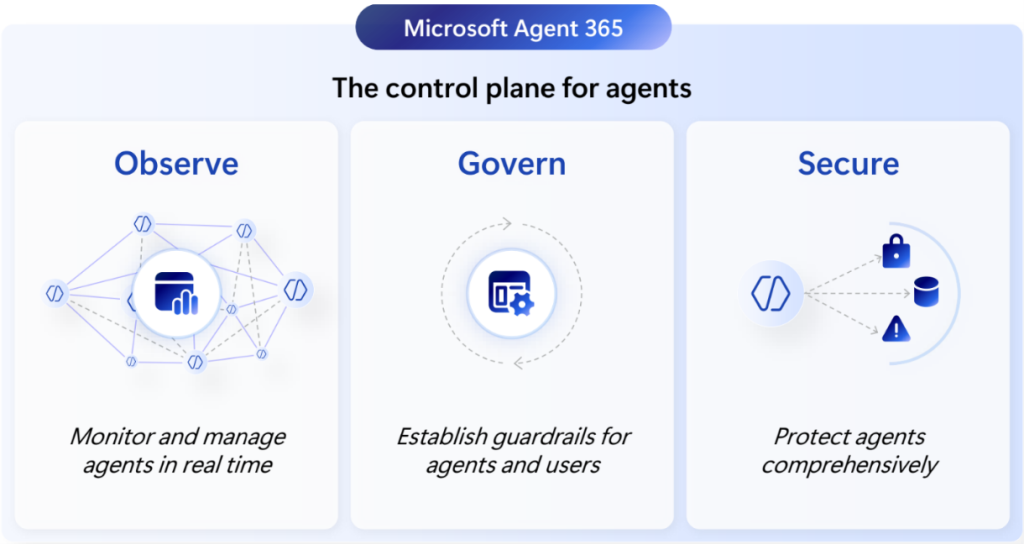
The bigger takeaway is that agent adoption is likely to accelerate faster than most organizations can define a mature operating model for it. That’s what makes governance such an important part of the conversation. The challenge is no longer just enabling agents, but making sure they remain visible, accountable and safe as they scale.
The real opportunity is services, not just software
When people hear “agent platform,” the instinct is often to think about how fast agents can be built. I think that’s the wrong starting point. In the agentic AI future, value won’t just come from creation. It will also come from orchestration, governance, security and accountability.
That’s where MSPs have a genuine opening. Agent 365 introduces workflows for:
- Controlled onboarding
- Least-privilege integration management
- Lifecycle policies
- Audit and logging
- Data compliance controls
- Access control
- Threat protection
MSPs who can help customers answer practical questions, such as which agents are sanctioned, how agent identities are protected, what data agents can touch, how inactive agents are retired and how risky behavior is investigated, will be operating in a much higher-value part of the AI stack.
Why this matters now, even if the market is still early
Most organizations are still early in their move from AI assistance to agentic execution. But that’s exactly why this moment matters. The patterns established now will shape how scalable, secure and governable AI becomes later.
Signals the market is moving in this direction:
- AI is expanding from assistance into action and process execution
- Customers are experimenting with agents across multiple tools, data sources and workflows
- Security and governance teams are starting to ask for the same oversight over agents that they already expect for users and apps
What MSPs should avoid:
- Treating Agent 365 as just another feature checklist
- Leading with licensing before customers have clarity on ownership, policy and control
- Assuming agents can scale safely without governance disciplines already in place
The winners in this market won’t be the MSPs who talk the most about agents. The winners will be the ones who help customers adopt agents without creating an operational mess they have to unwind later.
Where MSPs can build enduring value
If Agent 365 becomes the control layer for agents, then MSPs have the chance to build repeatable services around:
- Readiness assessments
- Onboarding standards
- Access design
- Policy templates
- Lifecycle management
- Compliance reviews
- Security monitoring
This is where the margin story gets interesting. The long-term value won’t just come from how many agents an MSP can help launch in a quarter. It’ll also come from becoming the advisor that customers rely on to keep those agents observable, compliant and secure over time.
That’s a stronger and more defensible position than competing only on deployment speed.
Three questions that should shape every Agent 365 conversation
Regardless of whether a customer buys Agent 365 today, these are the questions that matter if they’re moving toward an agent-driven future:
- What is our inventory of agents, and how quickly is it growing?
- What policies govern agent access to identities, data, tools and other agents?
- Who is accountable for monitoring performance, risk, business impact and lifecycle?
Those questions are the foundation of whether agentic AI becomes a scalable operating model or just another wave of unmanaged experimentation.
Final thoughts
The future of enterprise AI won’t be defined by a single assistant. It will be defined by networks of agents acting across the business. That’s why Agent 365 matters: it’s Microsoft’s acknowledgment that the agent era will need a control plane, not just creativity.
For MSPs, that creates a different kind of opportunity than the first wave of Copilot. This is not just about adoption. It’s about architecture, policy, lifecycle, oversight and trust. Those are all areas where strong services businesses are built.
If Copilot opened the door to AI productivity, Agent 365 points to what comes next: managed agent ecosystems. MSPs who start preparing for that shift now will have a head start when customers move from experimenting with agents to relying on them.
Ready to map out your Agent 365 strategy?
If you’re thinking through what the agentic AI future means for your customers or your services strategy, reach out to our team. Now is the right time to start the governance conversation. We’re happy to help assess where Agent 365 fits and how to turn it into a practical services roadmap.